Word Sort Fun!
- 4.0
- Rating
- 500.00K
- Installs
- Free
- Price
 Analysis by App-foxy
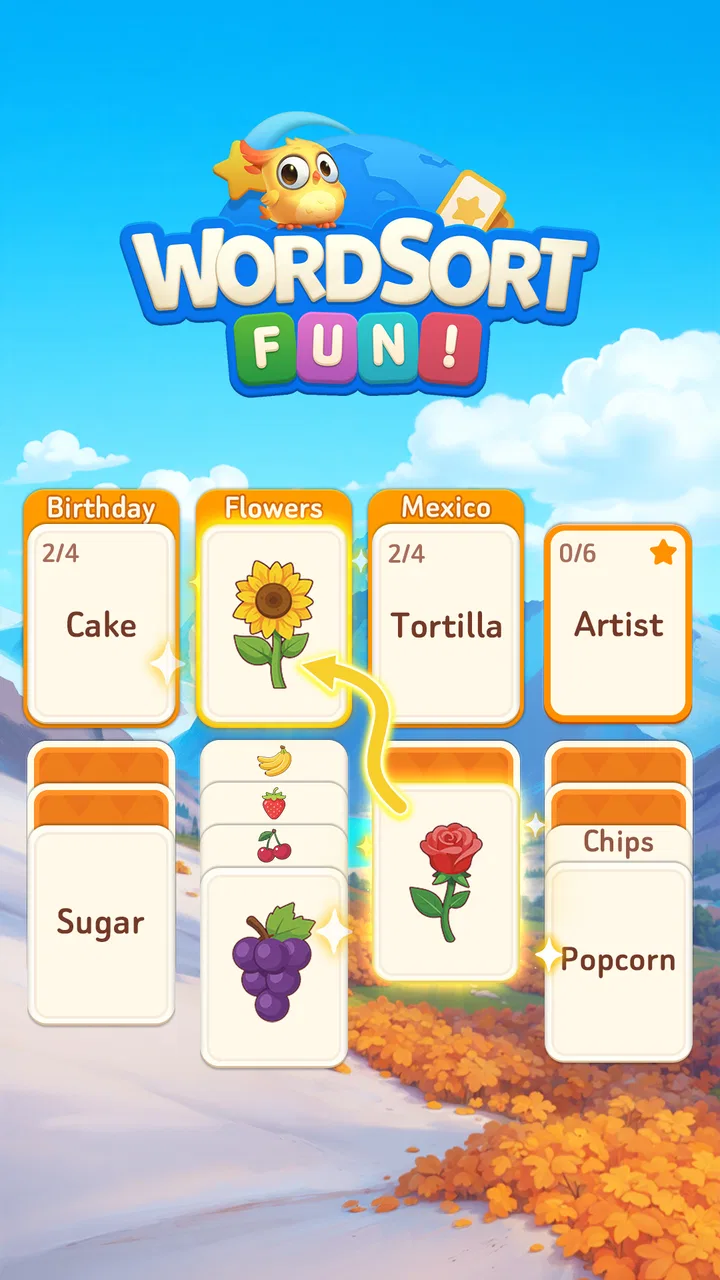
I spent time with Word Sort Fun as a small, focused word game rather than treating it like a full-scale brain-training package. Its basic idea is easy to understand: sort and match words in solitaire-style puzzles, then keep moving through one compact challenge after another. That simplicity is the main reason to try it, but it is also the key to deciding whether it belongs on your phone. If you want a calm word activity that can fill a few spare minutes, it makes a good case for itself. If you need deep vocabulary lessons, competitive play, or a large collection of modes, you may eventually want something broader.
The game comes from Cedar Games Studio and sits in the word category. It is free to install, rated for Everyone, and supports devices running Android 7.0 or later. I also found its presentation easy to approach: there is no need to learn a complicated control scheme before starting. The attraction is the mental sorting itself, not a long tutorial or an elaborate fictional setting.
How I decided whether it was worth keeping
For this type of game, I look at four things first: how quickly a puzzle becomes understandable, whether the challenge stays satisfying after the novelty fades, how well it works in short sessions, and whether its payment model gets in the way. Word Sort Fun performs best when judged as a lightweight daily pastime. It is not trying to replace a serious crossword book or a structured language course, and I would not choose it for those purposes.
You May Also Like

 Blood Strike: 2.5 Anniversary
Blood Strike’s Loadouts Turn Every Drop Into a Tactical Gamble
A close look at Blood Strike’s custom loadouts: how fast access to signature weapons reshapes its battle royale rhythm, rewards preparation, and narrows the gap between fights.

 Pandora - Music & Podcasts
Pandora’s Music Is Easy to Start, but Harder to Recover
Pandora’s strength is its low-effort path from a seed to a station. Its weak spot is how much confidence it asks you to place in connection, setup, and quiet recovery.

 8 Ball Pool
 Is Built on Rivalries, Rematches, and Routine
A close look at the rivalries, rematches, shared routines, and unanswered safety questions that turn a quick pool match into a persistent mobile community.

 Samsung Music
’s Quiet Strength Is Playing What You Already Own
Its reach comes less from spectacle than from dependable access to a personal library. That simplicity is both the app’s strongest retention engine and its ceiling.

 AccuWeather: Weather Radar
AccuWeather Review: A Quick, Clear Forecast for Everyday Decisions
For everyday plans, the best forecast is the one you can understand quickly. AccuWeather makes rain timing, radar, and local conditions easy to act on, with a few trade-offs.

 Hill Climb Racing
Why Hill Climb Racing Still Turns Crashes Into One More Run
A tiny car, a bumpy hill and one more upgrade: Hill Climb Racing keeps resurfacing because its simple chaos makes every near-miss feel personal.
More From Our News Desk



The first useful question is whether you enjoy recognizing relationships between words. The game’s sorting-and-matching premise rewards attention more than fast tapping. I found myself scanning groups, forming a possible connection, and then checking whether the remaining words still made sense. That creates a pleasant little cycle of prediction and correction. It is more involved than simply guessing a single answer, while still being less demanding than a long-form puzzle that requires uninterrupted concentration.
The second question is how much variety you expect from one title. A focused word-sort game can feel refreshing because it removes clutter, but the same narrow identity may become repetitive for players who want crosswords, anagrams, spelling drills, and daily competitions in one package. I would make that decision before installing rather than expecting the game to transform into a different kind of word app later.
Short sessions are where it fits most naturally. I could imagine opening it while waiting for an appointment, taking a break from work, or winding down without wanting a fast action game. The format encourages you to think in small bursts. That matters because a puzzle that can be paused mentally is more useful in everyday life than one that demands a fixed block of time.
The basic puzzle rhythm
What I liked most was the gradual movement from observation to commitment. At the beginning of a puzzle, several words can appear to belong together, so I resist making the first obvious match immediately. Instead, I look for the strongest relationship and consider what that choice leaves behind. This is a practical way to play, not just a theoretical tip: an apparently correct group can make the rest of the board awkward, while a less obvious connection can unlock a cleaner finish.
That makes the game feel closer to arranging clues than to racing a clock. I found it more enjoyable when I treated each board as a small deduction problem. If I became stuck, I stopped forcing a connection and reread the remaining words from a different angle. This approach is especially useful for people who like word puzzles but dislike being punished for playing slowly.
Another helpful habit is to separate certainty from possibility. I mentally mark one group as nearly certain, another as plausible, and the rest as unresolved. That prevents a tempting association from taking over the entire puzzle. It is a simple technique, but it gives the game more depth than its short description suggests.
Why the solitaire format works
The solitaire framing gives the experience a private, low-pressure character. I am not comparing my speed with another player while solving, and I do not need to coordinate a session with anyone else. That makes it suitable for a quiet break or for someone who prefers games that let them think without performance pressure.
It also changes the emotional tone of mistakes. When I make a poor grouping, the useful response is to reconsider the board rather than panic. Players who enjoy word games as a form of mental reset may appreciate that. On the other hand, people who need a strong sense of competition may find the solo structure too restrained. A social word game or a head-to-head title would be a better match for that audience.
The format is also friendly to mixed experience levels. Someone familiar with word puzzles can try to solve efficiently, while a casual player can simply explore associations. I would still avoid presenting it as an educational tool for children in a formal sense. The Everyone rating makes it broadly accessible, but accessibility and curriculum-based learning are not the same thing.
Where it wins against familiar alternatives
Compared with a traditional crossword app, Word Sort Fun asks for a different kind of vocabulary work. Crosswords usually depend on clues, crossings, and the ability to infer a precise answer from partial information. Here, the central task is recognizing which words belong together and managing the consequences of each selection. I prefer this game when I want a more open-ended puzzle that does not require filling a grid from top to bottom.
Compared with an anagram game, it is less about rearranging letters and more about meaning. That makes it a better choice when I want to think about categories or relationships rather than spelling speed. Someone who enjoys building words from a letter bank may find an anagram-focused alternative more rewarding, but that would not make this game weaker; it would simply reflect a different preference.
Compared with a spelling trainer, the appeal is more recreational than instructional. I would not open it expecting lessons, progress reports, or a carefully sequenced language syllabus. Its strength is that learning-adjacent thinking happens naturally while I play, without the app needing to behave like a classroom.
It also has an advantage over large game hubs for users who want a single clear activity. Bigger word collections can offer more choice, but they often make the decision of what to play part of the work. This title is easier to understand: open it, examine the words, and sort them. That directness is valuable when I have only a few minutes.
Small habits that improve the experience
My first practical tip is to avoid locking onto the most familiar category too early. Words can share more than one possible relationship, and the strongest-looking group is not always the correct one. I get better results by checking whether each word in a proposed set has the same kind of connection, rather than accepting a loose association because two items clearly fit.
My second tip is to use the remaining words as evidence. A group should not be judged in isolation. If selecting it leaves several words that naturally form a stronger group, that is a sign the choice may be sound. If it leaves a collection of vague leftovers, I reconsider before committing. This makes the game feel more like solving a logic arrangement than guessing vocabulary trivia.
My third tip is to reserve it for the right mental state. When I am tired but still want something mildly engaging, it works well. When I am rushing, distracted, or looking for instant stimulation, the same puzzle can feel slower than expected. The game rewards a little patience, so the best use case is a deliberate pause rather than a frantic filler between notifications.
What may make you choose something else
The narrow focus is the main limitation. If you install word games for constant novelty, a title centered on sorting and matching may not hold your attention as long as an app that rotates through several puzzle types. I would choose a broader alternative for family sessions where different players want different activities, or for anyone who gets bored once they understand a game’s central pattern.
There is also a difference between relaxing and effortless. The controls and premise are approachable, but the puzzles still ask me to inspect language carefully. That is a positive when I want mental engagement, yet it means the game is not ideal for someone seeking a purely passive distraction. A simple arcade game may fit better when the goal is reflexive play rather than thought.
The game’s free entry is appealing, although in-app purchases range from $0.99 to $99.99 per item. That spread is worth keeping in mind before spending. I would begin with the free experience and decide whether any optional purchase genuinely improves my routine, rather than treating payment as necessary from the start. For a casual word game, keeping the spending boundary clear is part of making the app feel comfortable.
I would also be cautious about choosing it as a replacement for a dedicated language-learning app. Sorting words can support attention to meaning, but it is not the same as practicing pronunciation, grammar, conversation, or planned vocabulary review. If your goal is measurable language progress, use a specialist learning tool and treat this as a separate pastime.
Living with the app over time
The current version is 1.14.13, and the game has reached over one hundred thousand installs with an average rating of 4.6 from around two thousand four hundred ratings. Those figures suggest that the basic concept has found a receptive audience, while the individual experience will still depend on how much you enjoy this particular puzzle rhythm. I would read the rating as evidence of broad appeal, not as a promise that every word set will suit every player.
There are also 313 written reviews, which can be useful when deciding whether the game’s style matches your expectations. I pay more attention to recurring comments about difficulty, pacing, and the value of optional purchases than to a single enthusiastic reaction. For this kind of title, personal tolerance for repetition matters more than a headline score.
Because it is free and rated Everyone, it is easy to suggest as a low-risk trial for a household with different ages. Still, I would explain the game’s purpose before handing it to a child: it is a puzzle for sorting word relationships, not an automatically guided lesson. Adults may enjoy it as a quiet break, while older children who already like word association games may appreciate the same structure.
A realistic everyday scenario would be a commute with a few interruptions. I could open a puzzle while waiting, solve the obvious relationships, and put the phone away when my bus arrives without feeling that I had abandoned a long campaign. Later, I can return with the remaining words and reassess them. That stop-and-start quality is more useful to me than a game whose main appeal disappears unless I play continuously.
Is changing from another word game worth it?
The cost of switching is low if your current app is a crossword or anagram game and you simply want a different mental texture. You do not need to relearn a complex control system; the adjustment is mainly conceptual. Instead of chasing a clue or manipulating letters, you inspect relationships among words and test a grouping. I would keep both types installed if they serve different moods.
The switch is less worthwhile if your existing app already offers several word modes and your main complaint is a lack of variety. In that case, adding a focused sorter may increase the number of icons without solving the real problem. Likewise, competitive players should not switch solely because they want more excitement. The solitaire character is central to the experience, so a multiplayer alternative will remain the better choice for social motivation.
For someone coming from a language-learning app, I would frame the change as adding recreation, not replacing study. Word Sort Fun can make a break feel more thoughtful, but it does not provide the structured repetition that makes formal practice effective. Keeping those roles separate prevents disappointment and makes the game easier to appreciate on its own terms.
My recommendation
I recommend Word Sort Fun to people who enjoy word association, quiet deduction, and short solo sessions. It is especially suitable if you want a free starting point, a broadly accessible age rating, and a game that can be picked up without a long explanation. Cedar Games Studio has chosen a clear identity, and that clarity is its strongest quality.
I would skip it if you need competitive events, a wide menu of puzzle formats, or a serious language curriculum. I would also avoid spending heavily before deciding that the core sorting loop belongs in your routine; the available purchase range makes that a sensible boundary. Try the free experience first, play slowly enough to notice the relationships, and judge it by whether you look forward to solving another board.
My final view is positive but specific: this is not a universal word-game replacement, and it does not need to be. Its best use is as a calm, focused puzzle for the gaps in an ordinary day. When that is exactly what you want, the straightforward design works in its favor. When you want variety, competition, or formal learning, another category will serve you better.
FAQs for Word Sort Fun!
01What is Word Sort Fun! and how does it work?
Word Sort Fun! is a highly engaging word puzzle game designed to challenge your vocabulary and cognitive skills. The game presents players with jumbled letters that need to be rearranged to form meaningful words. As you progress through different levels, the difficulty increases, requiring more strategic thinking and quick reflexes to solve the puzzles.
02Is Word Sort Fun! free to play, or are there in-app purchases?
Word Sort Fun! is free to download and play, providing a substantial amount of content without any cost. However, the game offers in-app purchases for additional features, hints, and boosts that can enhance the gaming experience. These purchases are optional and not necessary to complete the game, allowing players to enjoy it without spending money.
03Can I play Word Sort Fun! offline, or is an internet connection required?
Word Sort Fun! can be played offline, making it a perfect choice for on-the-go gaming without worrying about an internet connection. However, certain features, such as leaderboards and in-app purchases, require a connection to function. This ensures you can play anywhere while still accessing online features when needed.
04Does Word Sort Fun! have any accessibility features for players with disabilities?
Yes, Word Sort Fun! includes several accessibility features to accommodate players with disabilities. The game offers adjustable text sizes, high-contrast modes, and voice-over support to ensure a comfortable gaming experience for everyone. The developers are committed to inclusivity, regularly updating the app to meet diverse player needs.
05How does Word Sort Fun! ensure the privacy and security of its users?
Word Sort Fun! prioritizes user privacy and security by employing strict data protection measures. The app collects minimal personal data, mainly for improving user experience and gameplay. All data is securely stored and not shared with third parties without user consent. The app complies with standard privacy regulations, ensuring a safe environment for all players.
Pros
- Engaging and challenging puzzles.
- User-friendly interface and controls.
- Regular updates with new levels.
- Supports offline play mode.
- Encourages vocabulary development.
Cons
- Limited hints can be frustrating.
- Ads can interrupt gameplay.
- No multiplayer mode available.
- Requires in-app purchases to unlock features.
- Occasional performance lags.

Word Sort Fun!
Gallery